
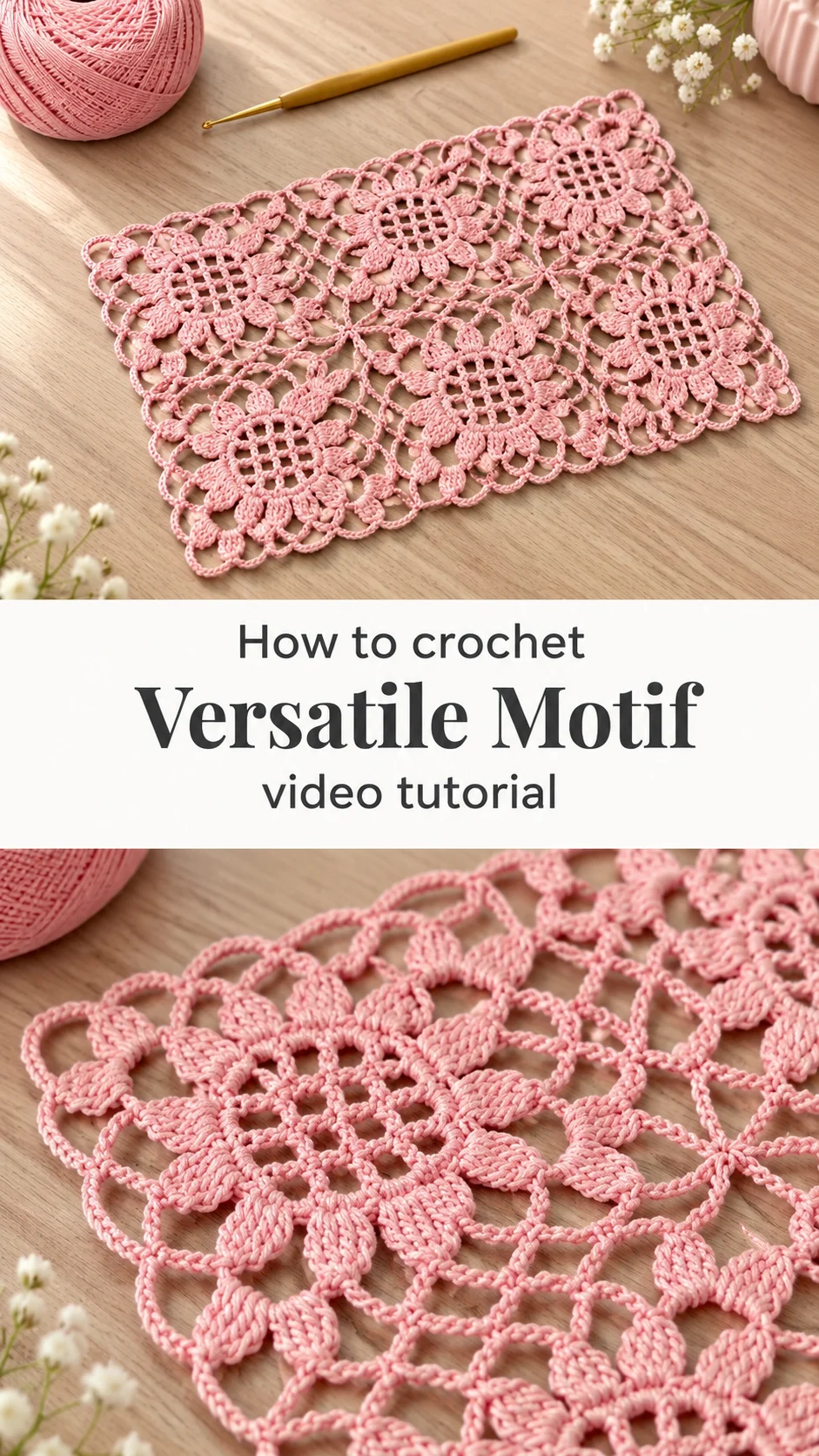
A pink mesh motif built from flower-shaped clusters and open lace squares, worked in a soft rose cotton that reads as both delicate and graphic.
The Crochet Versatile Motif
Crochet Versatile Motif is a piece that rewards close attention. Its central idea is a repeating flower of small leaf-like clusters that sit around a checkered open centre, and these blossoms are joined by a lattice of chain loops and arches. The result is a fabric that looks airy and lace-like from a distance but feels firm and structured in the hand. Each flower is a distinct unit, yet the connecting mesh ties them into a single sheet. The colour is a clear dusty pink, which keeps the design soft without losing definition. Because the motifs are so evenly spaced, the finished piece has a calm rhythm that suits almost any setting. It is a motif that works as a panel, a table topper or a building block for something larger.
The motif works equally well as a decorative insert, a runner or a mat. Its scalloped outer edge gives it a finished look even before any border is added, and the open lattice lets it sit lightly on a surface without feeling heavy.
Versatile Motif Related Posts:
- Crochet Hooded Cardigan: A Cozy and Elegant Wrap
- Crochet Butterfly Floral Top: A Whimsical Summer Essential
- Crochet Valdivia Cowl: A Warm and Timeless Essential
- Crochet Rose Embellishment: A Delicate Floral Accent
Materials
You will need a fine cotton yarn in a light or sport weight, the kind that gives crisp stitch definition and holds its shape after blocking. Mercerised cotton is a good choice here, since its slight sheen brings out the leaf clusters and keeps the pink looking clean. A steel or metal crochet hook in a size suited to fine thread will help the mesh stay even and open, while a smaller hook produces a firmer fabric that resists stretching. Keep a pair of sharp scissors, a yarn needle for weaving in ends and a set of stitch markers to track the repeat. A blocking surface and a few T-pins complete the kit, because the lace opens up and sharpens only once it is pinned and set.
Understanding the Motif Structure
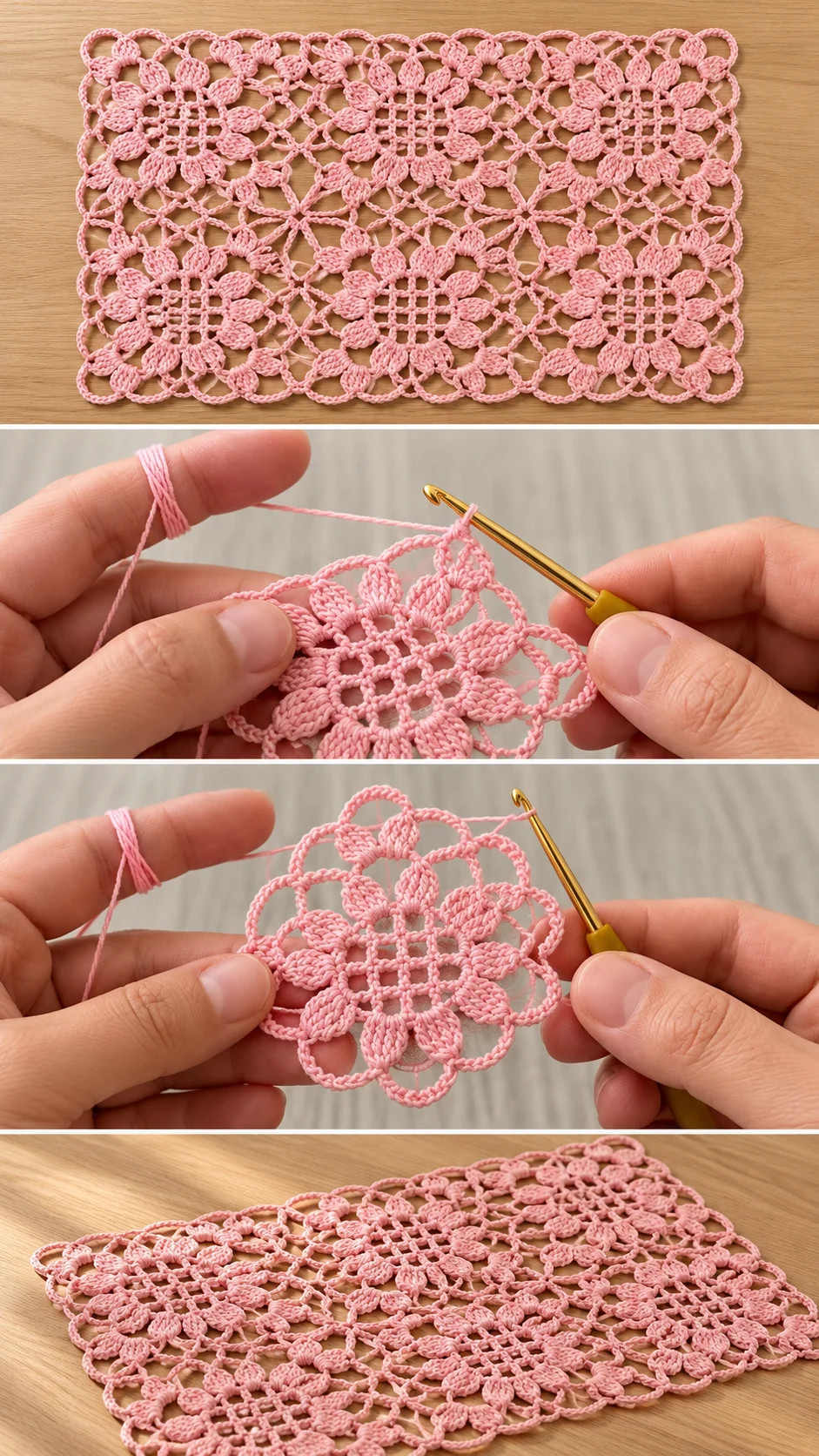
Each flower is made from a central checkered grid surrounded by clusters that rise slightly from the surface. Those clusters are what give the design its dimension, and they are the feature most worth studying before you begin. The flowers are then linked by chain arches that form the open lattice between them. Working out how each flower connects to its neighbours will save you from loose joins later. Because the motifs repeat, the fabric grows in a predictable direction, so keep track of which edge you are building from.
Why the Clusters Stand Up
The raised clusters depend on tight, consistent tension. If your stitches are loose, the leaves will flatten and the flowers will lose their outline.
Choosing the Right Yarn and Colour
A fine mercerised cotton gives the sharpest result, with clean stitch edges and a subtle shine. A softer cotton blend produces a gentler, more drapey fabric, though the leaf clusters will look less crisp. Avoid very fuzzy or heavily plied yarns, which blur the mesh and hide the open centre of each flower. The dusty pink in the photos is easy to repeat; a near shade such as blush or rose quartz keeps the same soft mood. For contrast, a cream or pale grey works well for the lattice while the flowers stay pink.
Assembling the Motifs
Work each flower to completion, then join it to its neighbours as you go, rather than making all the flowers first and sewing them together afterwards. Joining as you work keeps the spacing even and avoids a lumpy seam. If the lattice starts to pull the sheet out of shape, check the tension of the chain arches against the flowers and adjust before continuing.
Keeping the Edge Straight
Count your repeats at the end of each row. If one side gains an extra flower, the piece will curl, so correct it early.
Finishing and Blocking Tips
Weave in every end on the wrong side, running the tail through the back of several stitches so it cannot work loose. Blocking is essential for this design: pin the motif out to its finished size, mist it lightly with water and let it dry fully. Blocking opens the mesh, sharpens the leaf clusters and evens out any slight variations in tension. If the flowers look cupped, pin them flat from the centre outward.
How to Style a Crochet Versatile Motif
In the photos the piece is laid flat on a pale wooden surface, where its pink tones stand out against the natural grain. Use it the same way on a sideboard, a dresser or a bedside table. For a softer look, drape it over a wicker tray or a linen cushion. Several motifs joined together make a striking table runner, and a single panel can be framed as wall art.
Caring for Your Crochet Piece
Hand wash in cool water with a mild detergent, since harsh soaps can dull cotton and weaken the stitches. Lay the piece flat to dry, reshaping it while damp. Store it folded loosely in acid-free tissue rather than hanging it, which can stretch the lace over time. Keep it out of strong direct sunlight to protect the pink from fading.
Following the Video Tutorial
Watch closely how the flower centres are built, since the checkered grid is the foundation of every motif. Pause when the clusters are formed and notice how the hook is positioned, because that hand movement creates the raised leaves. Replay the joining section as often as you need to see how each flower connects to its neighbours. Work slowly through the first motif before attempting the full layout.
A Bold and Timeless Handmade Motif
This crochet versatile motif is a piece that makes its maker careful and patient. Its pink clusters, open lattice and even spacing give it a presence that suits many homes. Tension, careful joining and thorough blocking decide whether it turns out crisp or limp. Work with those three things in mind and the finished piece will look as deliberate as the photos.
Video tutorial by the original creator, linked here:
[Video]
Follow us on Pinterest and subscribe to the Newsletter so you don’t miss a thing!
Tutorial and photos of this versatile motif by: Crochet Knitting Therapy .