
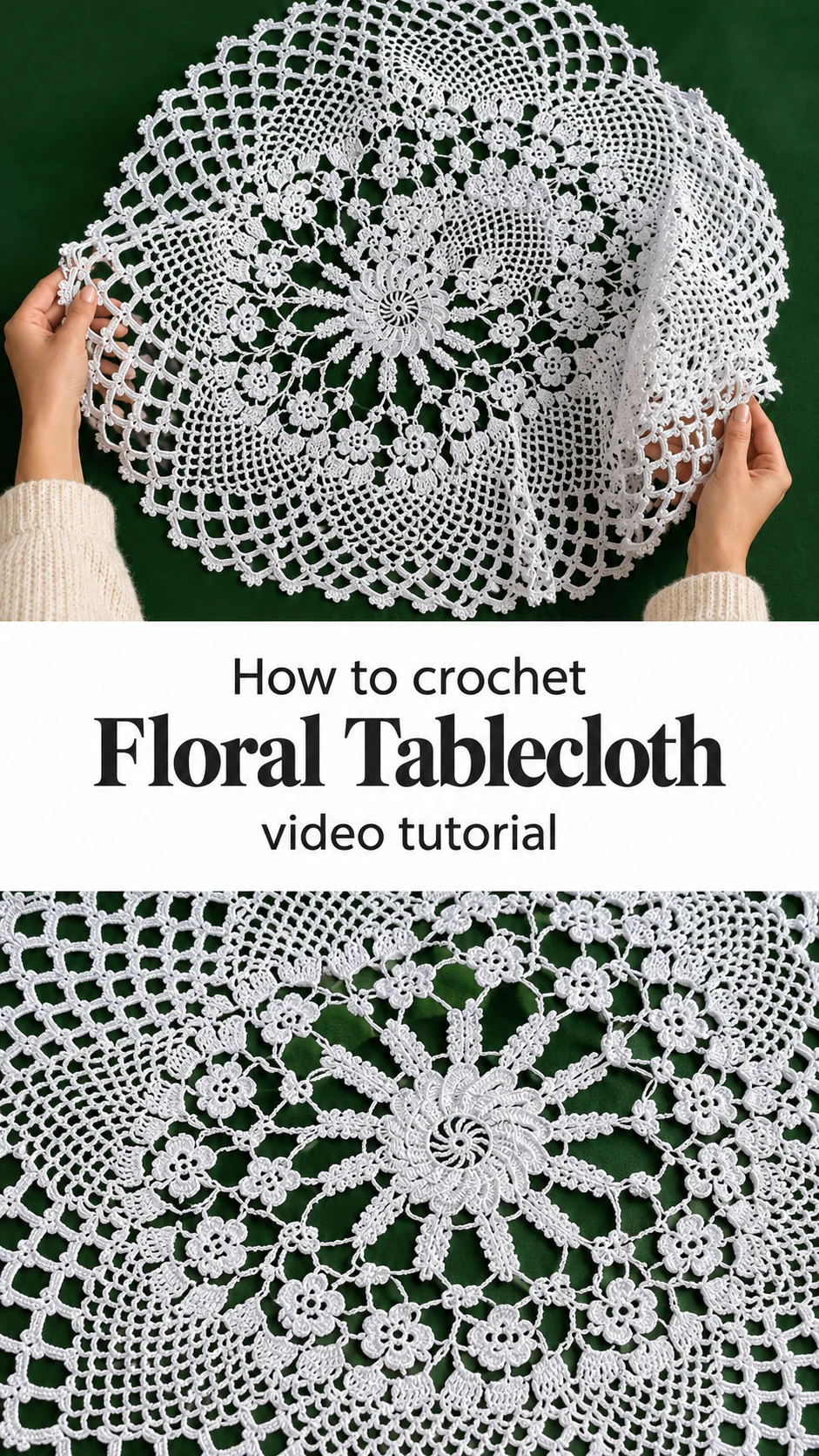
A lacy white floral tablecloth worked in fine cotton thread, where clusters of small blossoms float across an open mesh and a bold central medallion anchors the whole design.
The Crochet Floral Tablecloth
The crochet floral tablecloth is a piece that asks to be looked at closely. Its open mesh lets light pass through, its small flowers seem to rise out of the net, and its central medallion draws the eye inward like the hub of a wheel. Unlike a plain doily, this design builds its beauty in layers: a scalloped outer border, a field of mesh with flower clusters scattered across it, and spokes of raised texture that radiate from the centre. Those raised spokes are the feature that sets it apart. They give the surface a sense of movement, so the cloth looks almost embroidered even though every element is crocheted. Set it over a dark wood table or a deep green runner and the white thread glows. It suits a dining table for a special meal, a sideboard for a family gathering, or a corner that needs a touch of handmade softness.
Made in fine cotton, a tablecloth like this takes weeks of steady evenings rather than days. The pleasure is in watching the mesh grow outward from the centre, one ring at a time, until the full cloth spreads across the table.
Floral Tablecloth Related Posts:
- Crochet Chain Strap Bag: A Chic Timeless Accessory
- Crochet Pocket Shawl: A Versatile and Chic Accessory
- Crochet Snowflake Granny Square: A Delicate Winter Treasure
- Crochet Daisy Pot Holder: A Charming Floral Touch
Materials
A tablecloth of this kind is worked in a fine mercerised cotton thread, the sort sold for lace and doilies. Choose a thread with a slight sheen, since it catches light across the flower clusters and keeps the mesh crisp after washing. Avoid thick knitting cotton: it fills the open spaces and hides the mesh that gives the design its character. A small steel hook, usually in the range suited to lace thread, is the right partner. A finer hook gives tight, even stitches that hold their shape on a large cloth, while a looser one lets the mesh sag. A blunt tapestry needle is useful for weaving in ends, and a pair of sharp scissors keeps the thread clean. Because the finished cloth will be large, buy all the thread from one dye lot before you start, so the white stays consistent from the centre to the edge. Starch or a blocking solution is worth having on hand for the final shaping.
Understanding the Structure
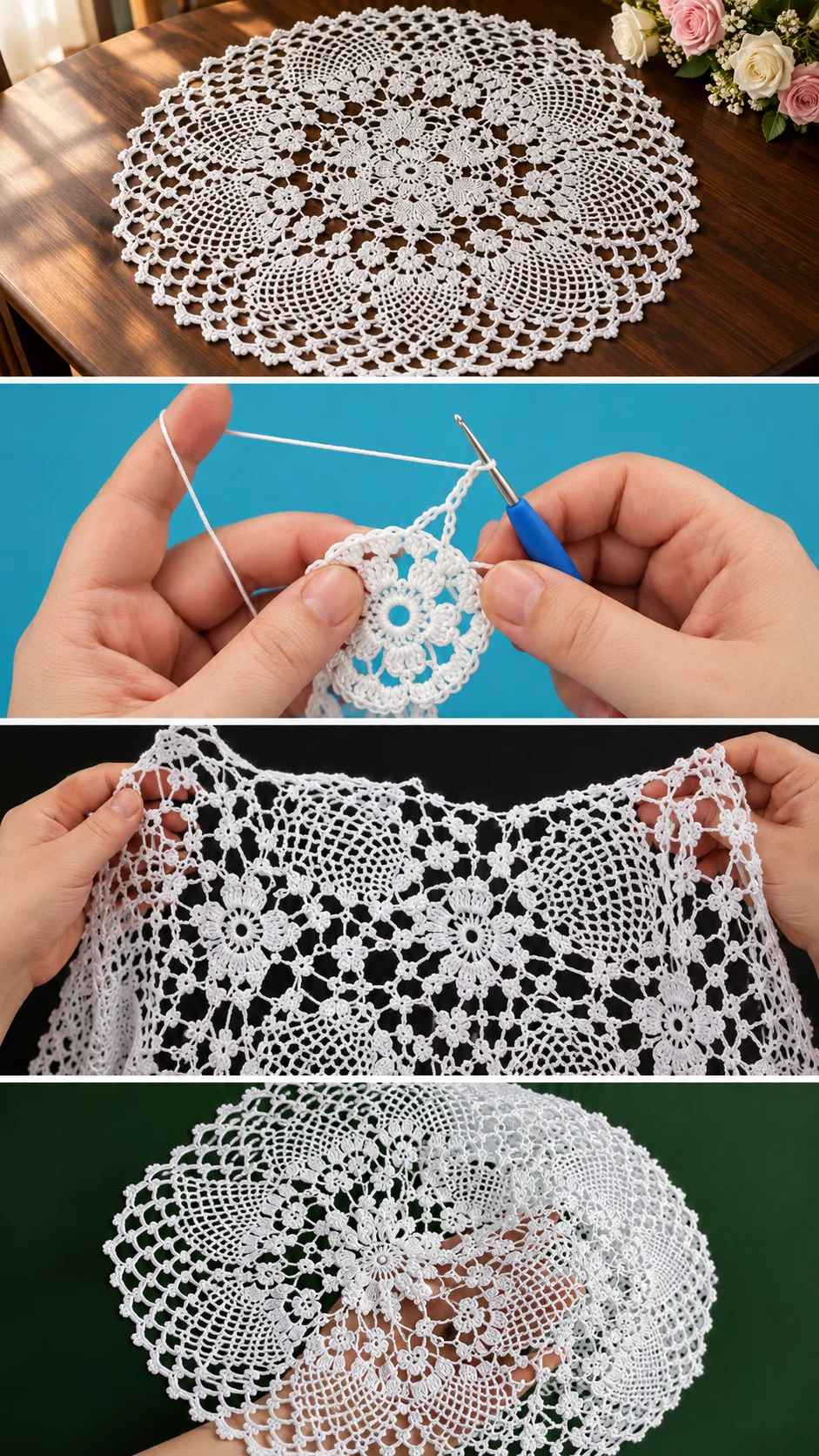
The cloth is built outward from a centre medallion. The medallion is the most compact part, with petals curling around a small open ring, and it sets the scale for everything that follows. From there, the work expands into a mesh ground with flower clusters placed at intervals, and the raised spokes travel out between them. Because the design grows from the middle, the shaping that keeps it flat happens through the number of stitches added in each round rather than through any single seam. If the cloth starts to cup or ripple, the problem usually sits in the mesh rounds, where too few stitches have been added to fill a growing circle.
Keeping the Centre Flat
A medallion that lifts at the edges usually has tension that is too loose in the first rounds. Work the centre a little tighter than feels comfortable, and the flat start will carry through the whole cloth.
Signature Detail: The Raised Spokes
The spokes that radiate from the medallion are the most distinctive part of the design. They are worked as short, dense runs that stand slightly proud of the mesh, which gives the cloth its three-dimensional look. The choice you face is how tightly to pack them. Pack them densely and they stand out boldly, but they can pull the surrounding mesh out of shape. Work them more loosely and they stay flat, which keeps the cloth calm but loses the sense of movement. The mistake to avoid is making every spoke tighter than the last, which slowly draws the outer edge inward. Keep the density even across all the spokes.
Finishing the Edge: Scallops and Blocking
The scalloped border is what frames the cloth, and it deserves patience. Each scallop should be the same depth, which is easiest when you count the spaces between picots as you go. Once the whole tablecloth is complete, blocking is essential. Pin the cloth out on a clean towel or foam board, gently stretching each scallop to its full shape, and mist or apply a light starch solution. Let it dry completely before moving it. Blocking settles the mesh, opens the flowers and gives the border its crisp outline. Skipping this step leaves the cloth looking limp, however carefully it was made.
Tips for a Smooth Build
Work with good light and in short sessions, since fine thread is tiring on the eyes. Check your gauge by measuring a small square of mesh against the same square in the photos. If the flowers look crowded, the hook is probably too large. Weave in every end as you go rather than leaving a pile for the end, so the finished cloth lies flat on the table.
How to Style a Crochet Floral Tablecloth
In the photos the cloth is shown spread wide, its scalloped edge falling in soft curves. That is how it looks most striking: drape it so the border hangs slightly over each side of the table, with the medallion centred. For a dinner, layer it over a solid linen cloth in a warm neutral, so the white mesh reads clearly. For a summer lunch, use it on a pale wooden table with pale green napkins. Over a dark walnut sideboard, fold a corner back to show the mesh against the wood. It also works as a sheer backdrop on a console table, with a simple vase in the centre.
Caring for Your Crochet Floral Tablecloth
Hand wash in lukewarm water with a mild, pH-neutral soap, and avoid rubbing the mesh, which can snag fine thread. Rinse thoroughly and press the water out gently in a towel rather than wringing. Dry flat on a clean towel, re-blocking if the shape has shifted. Store it folded loosely with acid-free tissue between the folds, so the crease lines do not set into the thread.
Following the Video Tutorial
Watch the video closely for the hand position on the raised spokes, since that is where the texture is made. Pause and replay whenever the creator joins a new round, and notice how the stitch count builds the outward growth. Work in a sensible order: centre first, then the mesh rings, then the border, leaving blocking for the very end. Take your time with the medallion, because every later round depends on it lying flat.
A Timeless Handmade Treasure
The crochet floral tablecloth rewards patience with a piece that feels both delicate and sturdy, built from fine white thread into a centre that draws the eye inward. Four things decide how well it turns out: the evenness of the mesh, the density of the raised spokes, the consistency of the scalloped border, and a thorough blocking at the end. Work those carefully, and the finished cloth becomes an heirloom.
Video tutorial by the creator of this floral tablecloth design, linked here for you to follow along.
[Video]
Follow us on Pinterest and subscribe to the Newsletter so you don’t miss a thing!
Tutorial and photos of this floral tablecloth by: Crochet Swan.